TMJ Pain Relief Without Medication in Reading, PA
Hey guys, Dr. McClimon back with McClimon Chiropractic, and today we’re going to talk about TMJ, or temporomandibular jaw syndrome, which is where you basically have pain in your jaw.
Understanding TMJ Pain
If any of you have experienced this before, it’s really uncomfortable. But it is common. About 5% to 12% of the population will experience this at some point, and chiropractically, there is something that we can do to help that.
Typically, they might give you a muscle relaxer or a painkiller to help reduce the inflammation and pain. But chiropractic, again, looks at the structure because the structure typically dictates the function.
How the TMJ Works
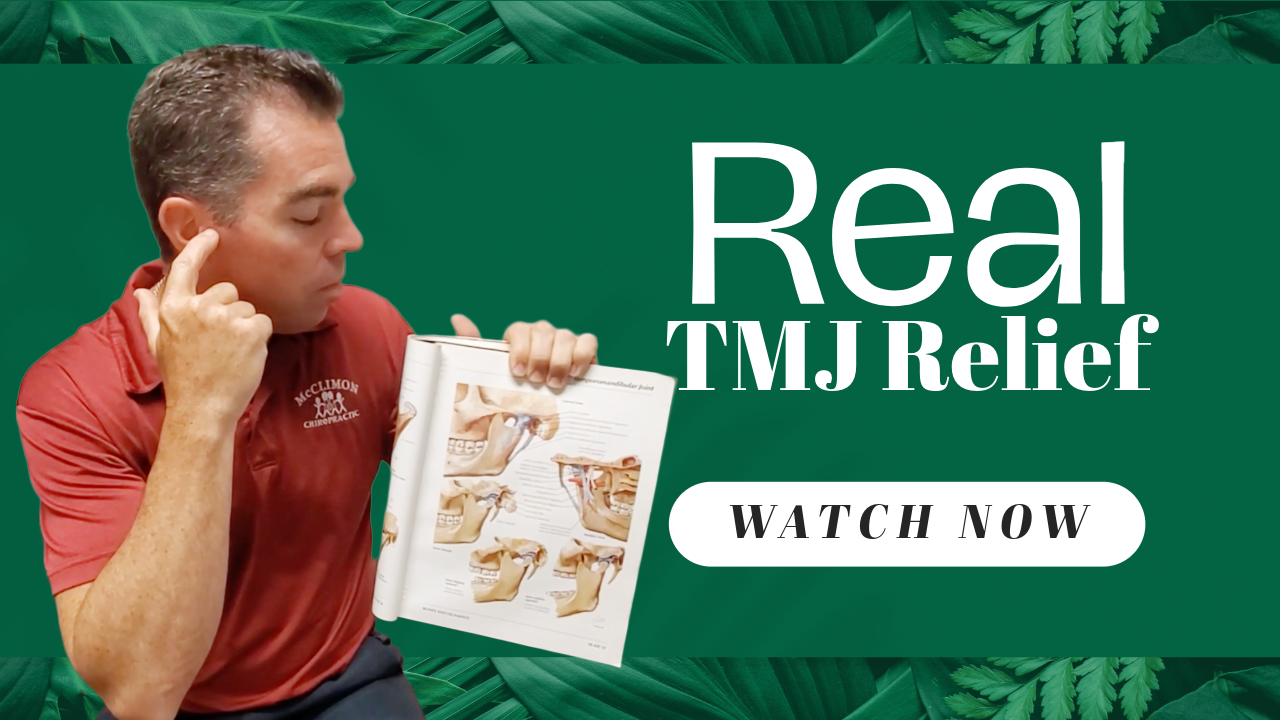
Guess what this is? This is called a textbook. For those out there who have never seen one of these before, this is called a textbook. I’m using it for a demonstration of the picture.
Here you can see the actual TMJ joint, which is right here, where your jaw meets your skull. It’s called a hinge joint. You can see it right here if you’re not familiar.
Basically, the jaw comes in and meets like this. Then, as you open and close it, it shifts like this.
Inside that joint, there’s a fibrocartilaginous disc that acts as a cushion. As you open and close your jaw, that disc slides forward and backward.
What Causes Clicking, Popping, and Pain?
Sometimes the jaw joint itself can actually shift. When it shifts, it can alter that disc material between the joint. That’s where we get that clicking, popping, and sometimes pain.
Chiropractic can do an evaluation through an exam and X-rays to see if the alignment of the TMJ is in a good position. If it’s not in a good position, we can actually make specific adjustments to the TMJ to improve that alignment.
Why We Start With the Cervical Spine
I will say this: The TMJ is the most proprioceptive joint in the body, so it’s very, very sensitive. We don’t like to work on it until we have made sure that the cervical spine is cleared out.
If there is subluxation or misalignment in the neck, that can also contribute to TMJ. Many times, we find that clearing out the cervical spine and making sure there’s no misalignment there first actually clears out the TMJ. So we always start there.
If that doesn’t clear it out, then we’ll actually move to the TMJ. We can make adjustments to realign it and improve the function and structure there.
Chiropractic Care for TMJ
Guys, if you’re struggling with TMJ, traditional approaches haven’t helped you, and you haven’t tried chiropractic, it really is something that helps a ton of patients—and it could help you.
God bless.