


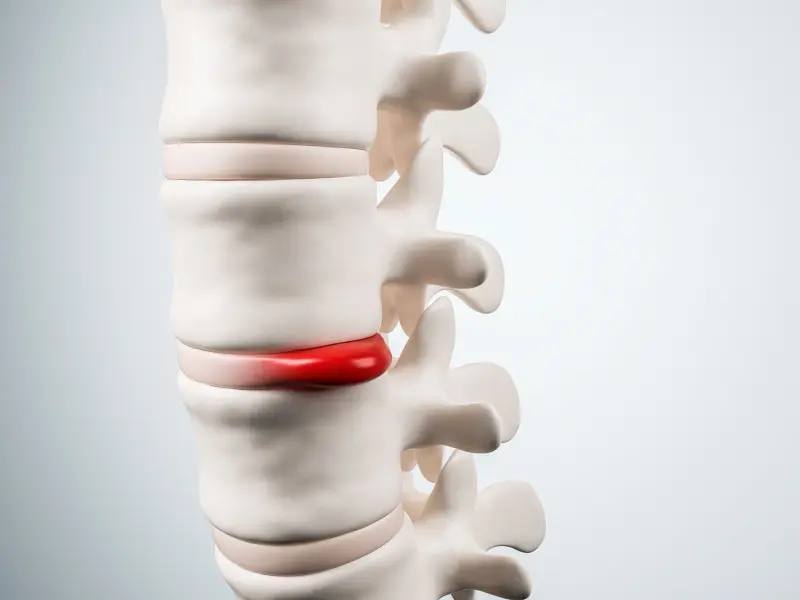
Spinal discs, or intervertebral discs, are fibrocartilaginous joints situated between the vertebrae in the spine and act as shock absorbers and provide flexibility. They have a tough outer cover, or annulus fibrosus, and a jelly-like center, or nucleus pulposus, which allows bending and motion in the spine and protects against compressive forces. The disc’s primary purpose is to provide shock absorption, structural support, spinal mobility, and protection against the bony vertebrae grinding against each other. When a disc is injured, the jelly material squeezes out, putting pressure on nearby nerves and creating localized pain, sciatica, numbness, tingling, and weakness in the limbs.
There are 3 phases of disc herniation. The first phase is a disc bulge. This is where the disc is injured, and the jelly oozes slightly. The second phase is called a disc protrusion, in which the disc is injured and protrudes slightly, putting pressure on nearby nerves. The third phase is a disc herniation, where the outer protective cover, or annulus fibrosus, tears, and the jelly squeezes out severely, putting pressure on nearby nerves. The causes of disc injury are primarily sudden trauma like falls and accidents, repetitive strain injuries from improper lifting or prolonged sitting, and degenerative disc disease from disc dehydration with age, obesity, smoking, and genetic predisposition. It is best to deal with a disc injury ASAP because it can prevent permanent nerve damage, chronic pain, irreversible loss of mobility, reduce inflammation, and avoid surgery. Good preventive measures include proper lifting techniques, exercise, good posture, and weight management.
Disc bulge is very common today, and one main reason is that most people do not take care of their spines. Imagine if you only brushed your teeth when they hurt, would your dental hygiene be better or worse than someone who brushes every day? Your spine is what houses and protects your nervous system, which runs every cell, tissue, organ, and function in every human being’s body, and it’s the last thing we check if we ever check it. The system that runs every function of your body should not be the last thing we check; it should be the first. And if the body can’t heal itself due to some limitation of time or matter, thank god we have alternative medicine, surgeries, and therapies to help us, but checking the spine that houses and protects the nervous system that runs your entire life shouldn’t be the last thing we check; it should be the first. If you don’t brush your teeth, your dental hygiene will worsen. If you don’t take care of your spine, you will have worse spinal hygiene. This is not a belief; this is a fact. So, when we go months, years, decades, or even a lifetime without checking our spine for misalignment that impacts our neurological and muscular systems, we shouldn’t be surprised when it ends in a disc injury.
The main difference between treatment for disc bulge, conventional, and the chiropractic approach is that medicine typically will address the symptoms with medication and therapy, while chiropractic addresses the root cause of the symptoms by removing misalignment or subluxation with specific adjustments to restore proper alignment and nerve flow, allowing disc bulge to heal form inside-out versus treatment from outside in. This is extremely safe and has no side effects, unlike medication and surgery. Improper spinal alignment not only causes a disc bulge but also leads to osteoarthritis, or “wear and tear” arthritis. If you drive on a crooked tire, it wears out faster. If you live with a crooked spine, it wears out faster. We don’t get osteoarthritis because we are old; we get osteoarthritis because we have old misalignment. So, not only is losing spinal alignment causing you potential pain and disc bulge, it will begin the process of osteoarthritis or degenerative disc disease, which creates more pain and dysfunction and irreversible damage.
If your spine is out of alignment or subluxated and you eat healthy, take a pill, do therapy, take supplements, or get an injection, will that change the structure of your spine? NO, the only thing that improves the structure of the spine is specific corrective chiropractic adjustments that address the root cause of the disc bulge, rather than just masking the symptoms. If you don’t improve the structure, the problem won’t go away. Biomechanics matter, and if there is misalignment, there will be structural compromise, often leading to osteoarthritis or joint problems, muscular imbalances, and neurological imbalances, such as disc injuries, which can lead to a host of possible problems.
So, what causes subluxation? Subluxation can be caused by daily activities like sitting, standing, poor posture, poor sleeping habits, and more obvious things like our work injuries, sports injuries, slips and falls, auto accidents, and even the birth process. Only about 10% of our nerves are pain nerves, so Cervical subluxation can contribute to disc bulges, but it more commonly contributes to many other conditions we don’t think of as high blood pressure, insomnia, allergies, vision difficulties, eczema, and thyroid conditions. Let that sink in…MOST Dysfunction we DON’T FEEL, but what do we base health on? Yes, how we feel. This is the recipe that has misled Americans for decades! The 2 top killers in the U.S. are heart disease and cancer. Do we feel heart disease and cancer? No, 2 things we don’t feel but we still base health on how we feel?? It’s not congruent, and it doesn’t make any sense. The reason we do that isn’t that it’s true; it’s because big pharma has trained us to do that. This is where the paradigm of health is backward today and how Chiropractic drastically differs from typical medical care. The spine, which houses your nervous system that runs EVERY function of our body, shouldn’t be the last thing we check; it should be the first. And if the body can’t heal itself due to some limitation of time or matter, thank god we have alternative medicines, therapies, and surgeries to help us, but that shouldn’t be first; taking care of the spine should be. This doesn’t sell drugs, but it does create a proven lifestyle success strategy to create healthy human beings without the use of drugs or surgery. It ensures the flow of information that keeps the body healthy and healing is operating without any interference. This not only results in less disc bulge or herniation, but also provides healthcare, not sick care, restoring and maintaining optimal function throughout the body for a lifetime.
$149 New Patient Special
Includes consultation with your doctor, thorough chiropractic examination, first treatment and customized plan of action.
How Our Care Plan Works
1. Finally Be Heard
Too often, patients feel like just another number in a crowded waiting room, leaving them frustrated and unheard. We believe your recovery starts with a conversation. That’s why we dedicate a full 30 minutes to your initial exam—giving you the floor to share your history, your concerns, and your goals. We’re here to listen intently, ensuring that the path we build together is one that finally puts your needs first.
2. Tailored Plan Of Attack
Knowledge is the first step toward lasting health. Once we’ve analyzed your exam results and digital X-rays, you’ll return for a detailed Report of Findings. We don’t just tell you what’s wrong; we show you why it’s happening. Together, we’ll walk through a personalized care plan tailored specifically to your lifestyle and goals. Our objective isn’t just a quick fix—it’s a sustainable strategy designed to resolve the root cause of your discomfort and prevent it from returning.
3. Take Back Control Of Your Health
Health is wealth. While resolving your symptoms is our first priority, our ultimate goal is to empower your future. We shift the focus from how you feel to how you function, teaching you the principles of spinal hygiene and proactive wellness. By investing in your health today, you aren’t just adding years to your life—you’re adding life to your years, ensuring you have the energy and mobility to enjoy every moment with the people you love.
Common Causes of a Disc Injury In Birdsboro & Reading, PA
Subluxation
In simple terms, this is when a bone of your spine shifts out of alignment and causes abnormal pressure on your discs and nerves. This can create pain among many other symptoms represented on the spinal nerve chart. Sometimes we feel subluxation but most of the time we don’t as only about 10% of our nerves are pain nerves. So, this is why basing health on how we feel, as big pharma has trained us for years is a bad idea. We find subluxation through examination and x-ray and make specific adjustments to restore proper alignment and nerve flow which restores the body’s innate intelligence and usually eliminates the pain and all symptoms associated with the compromised level of nerve dysfunction. A chiropractor is the only healthcare professional trained to detect and correct subluxation.
Repetitive Motion and Stress
Jobs and activities that involve repetitional motion are a major cause of disc injury. Jobs that include a lot of repetitional twisting, bending, lifting, or turning and involve poor posture will create abnormal stress on the discs creating small micro tears in the protective coat around the disc and can lead to a larger tear and disc herniation over the course of months or years. One of the best ways to prevent repetitional strain injury to discs is to be aware of your posture and ergonomics and maintain good posture, minimize the repetition when possible, and balance your repetition between both sides. Utilizing machinery and tools to work smarter and not harder is also beneficial. If you do get injured while working it is best to get a professional evaluation by a chiropractor who is trained on evaluating spinal structure and function so you can recover as quickly as possible and learn how to possibly prevent future injury. Chiropractic is covered 100% under workman’s comp to get the employee back to pre-injury status.
Heavy Lifting
Another common cause of disc injury is heavy lifting. Heavy lifting in a gym would consist of 80-85% of your 1-rep max. If you are lifting something 5 times or fewer and your form breaks down, it is heavy lifting. Heavy lifting causes disc injury when excessive pressure or shear force exceeds the capacity of the spinal structure, typically due to improper form, excessive weight, or repetitive strain. The proper way to lift is with proper form, good posture, not lifting too heavy, and not lifting when already tired. Do not lift with a rounded back. Keep your back straight and use your legs. Do not twist and rotate while under a heavy load; this is extremely stressful on the disc fibers and can lead to injury. Make sure you maintain strong core strength to lessen the force on the lower back muscles and discs. Disc injuries can usually be corrected with consistent chiropractic care techniques and home therapy, but if the disc is severely ruptured, it may require surgery.
Tech Neck
Tech Neck is the loss of the normal lordotic forward neck curvature due to repetitive stress from looking down at smartphones, iPads, laptops, computers, and other technological devices. It is extremely prevalent because Americans spend so many hours a day on their devices. The cervical spine normally has a forward or lordotic curvature, which is about 7x stronger and can absorb about 20-30x more compressive forces than a hypolordotic straight neck or kyphotic cervical spine that actually goes backward.
With the significant increase in the use of smartphones, which is about 97% of adults, and the use of other laptops and computers, humans are looking down literally half of their day, and it is destroying the normal cervical curve for people. The average American spends over 5 hours per day on a device, and Gen Z spends over 6.5 hours/day. It shouldn’t be a surprise when people look down this many hours a day and wonder why they have neck pain?? With this level of usage, it has a ton of detrimental health effects, but one of the greatest is the destruction of the cervical curvature and, ultimately, disc injury and degeneration. This not only causes neck pain and headaches but also significantly impacts many areas of health, depending on the nerves affected by the misalignment.
Another reason tech neck is so bad is Wolff’s law: the body responds to the stresses put upon it. If you drive on a crooked tire, it wears out faster. If you live with a crooked spine, it wears out faster. We don’t get osteoarthritis or “wear and tear” arthritis because we are old; we get osteoarthritis because we have old misalignment. So, not only is losing your cervical curvature causing you neck pain, it will begin the process of osteoarthritis or degenerative disc disease, which creates more neck pain and irreversible damage short of surgery.
Auto Accident
Whiplash is a neck injury caused by a sudden, forceful, whipping back and forth movement of the head. This creates sudden excessive force on the discs and can injure them acutely. Whiplash most commonly happens from rear-end auto accidents, but it can also happen from sports injuries, falls, and other physical impacts to the head and neck area. Whiplash commonly causes subluxation in the neck and upper back resulting in neck pain, stiffness, headache, shoulder pain, and reduced range of motion. It can also result in dizziness, fatigue, and chronic pain if not addressed. If you think you may have had whiplash it is important to be aware that symptoms may not begin for weeks or months after the injury. The chiropractic approach to whiplash is a thorough consultation and examination, followed by x-rays and a thorough doctor’s report to review the findings and give recommendations to get the patient back to pre-injury status. The treatment consists of a series of chiropractic adjustments, home exercises, and possible adjunctive procedures. This approach is superior to all other approaches simply because it is addressing the root cause of the problem and not just the symptoms. Chiropractic care covers auto accident cases 100% until the patient has returned to pre-injury status.
Respiratory Illness
Respiratory illness can create aggressive bouts of coughing which are a known acute cause of disc injury. Common respiratory illnesses that can dramatically increase intra-abdominal pressure from coughing and cause disc injury are bronchitis, pneumonia, and influenza. Asthma has also been mentioned as a possible culprit. To prevent disc injury while sick you can stabilize your spine by bracing your abdominal musculature, avoiding forward bending, and supporting your back against a solid object while coughing.
Degenerative Disc Disease
Degenerative Disc Disease or DDD is the wear and tear arthritis or Osteoarthritis of the spine to the point where the disc or cushion between the vertebrae starts to degenerate or thin. There are 4 phases of degenerative disc disease.
Phase I is where the spine is out of alignment but has not decayed or degenerated yet, phase II is where the spine is out of alignment and there is thinning of the disc with associated osteoarthritis or bone spurring creating nerve pressure, phase III is when you begin to see more severe disc degeneration and osteoarthritis creating more nerve pressure, and Phase IV is when the disc is so decayed it fuses to the one next to it. DDD causes the disc space to decrease, which narrows the nerve hole, increasing pressure on the nerves and affecting how they work and how you work. Someone with DDD will usually experience pain, inflammation, and decreased range of motion.
The number one risk factor for DDD is poor posture or poor spinal alignment. So please be conscious of your posture and ergonomics with technology and devices; this is one of the best ways to prevent and/or treat DDD. DDD and disc injury is not created because your spine is in good alignment, it is created because your spine is in a bad alignment. If you drive on a tire that is out of alignment, it wears out faster. If you live with a spine out of alignment, it wears out faster; it’s called Wolff’s law and is just physics. So, yes, our body becomes less efficient at repairing joint tissue as we age, and low-grade inflammation over time can contribute to some cartilage loss. But we mainly don’t get osteoarthritis or DDD because we are old; we get it because we have old misalignment.
The best way to treat Osteoarthritis or DDD is early detection with a series of specific chiropractic adjustments and customized postural exercises. Once you get it, you can’t get rid of it. So, having your spine checked at an early age is the best way to prevent it. If you have DDD, specific chiropractic adjustments can still help improve alignment and function, increase joint motion, and reduce nerve pressure and pain.




How We Treat Disc Injury in Birdsboro & Reading, PA
Comprehensive Consultation and Exam
At McClimon chiropractic we know in order to eliminate disc bulge we must first accurately diagnose it. Upon greeting the patient by name and giving them a tour on the way back the doctor will help educate them on what it is we do. We then listen to the patient through a thorough consultation of their signs, symptoms, and history. You will have an opportunity to discuss your specific problem with the doctor and have all of your questions and concerns answered. After the consultation the doctor will perform appropriate orthopedic tests, a palpation exam, a postural exam, and spinal range of motion testing. Once all exam information is compiled the doctor will recommend appropriate x-rays and to schedule their day 2 doctors report of findings to review all of their findings and recommendations.

Digital X-rays
We believe that to see is to know and not to see is to guess, and we don’t guess with our patients’ health. Our state of the art digital x-ray machine is essential to fully evaluate the health or sickness of the spine and how to precisely make our specific chiropractic adjustments based on your misalignment or subluxation pattern. They not only allow us to see what is there but also allow us to monitor our progress or regression if future films are warranted. They are also valuable for screening for any pathology or contraindications that may require adjustment. There are circumstances in which they may not be used, such as being pregnant. Please note that disc bulges or herniations do not appear on X-ray because they are soft tissue structures. They are clearly seen on MRI. X-ray will allow us to see misalignment and degenerative disc disease, which are often associated with a disc bulge. If symptoms are severe, we will refer out for additional testing such as an MRI or CT scan.
Report of Findings
This is your second appointment to review what we found in your examination. This appointment is about 30 minutes and will be extremely educational. We will discuss your findings and our recommendations based on your health goals. Then we will discuss your insurance benefits if you have insurance and how they participate. You will know exactly how often you will need to come in, how long it will take to correct your problem, and how much it will cost. Once all of your questions are answered you will be taken up front for your first adjustment.
Specific Chiropractic Care
When a disc is injured, it often bulges outward, narrowing the hole through which the nerve leaves your spinal cord, and it can also bulge inward, putting pressure on the spinal cord. It will also usually lose disc height. Both things contribute to what they call foraminal stenosis or spinal canal stenosis, which means the disc is putting pressure directly on your spinal cord or on the exiting nerve root. This will create dysfunction of the nerve and what it controls in the body. This can create pain and sciatica, or you may not feel any outward symptoms at all. This is important because if you have a subluxation and a disc bulge pressing on a nerve, it can cause various symptoms depending on which nerve is involved.
The spinal nerve chart is like the electrical panel of the body. It shows the nerve level and what can be impacted by pressure from subluxation or disc bulge at that level. For example, if you have a disc bulge or nerve pressure on your C6 nerve root, it could cause neck pain or pain in your shoulder, arm, and hand. Pressure on your C2 nerve root, such as a disc bulge, can cause sinus problems, allergies, earaches, and headaches. Pressure or a disc bulge on the C1 nerve root can cause headaches, high blood pressure, insomnia, nervousness, migraines, dizziness, or chronic tiredness, among other symptoms. Pressure or a disc bulge at L3 could cause sciatica, bladder problems, or menstrual problems.
Once subluxation or misalignment is identified through your examination and x-ray, the adjustment is the specific treatment to reduce or remove subluxation, restoring the body’s normal alignment and innate intelligence, restoring proper nerve flow and function, reducing inflammation, and improving mobility, which will help eliminate symptoms without the use of drugs or surgery. This is extremely safe and effective. Over 300 people die per day from properly prescribed drugs; no one dies from a specific chiropractic adjustment.
Therapeutic Exercise Plan
Exercise is an important part of your recovery and healing process, as well as helping you achieve your full potential. Subluxation or spinal misalignment will create poor alignment and altered biomechanics, often leading to muscular imbalances. It is important to note that exercise helps support adjustments and improve flexibility and range of motion, but stretching alone will not address the root cause of the imbalance and ultimately will not provide lasting results. Exercise helps to mobilize tissues, stabilize them, and reinforce proper functional movement.
We guide all patients through a series of spinal hygiene exercises to improve and reinforce good posture and disc health. These are designed for all areas of the spine. One of the most common problems we see today is forward head posture and a loss or even reversal of the cervical curve. This is largely due to the increased use of technology and computers, which can create hours of poor posture and ultimately affect the structure, nervous system, and your health. Research shows that a loss of cervical curve or other spinal curvature can severely impact disc health, longevity, and quality of life by causing chronic pain, nerve compression, and accelerated spinal degeneration or osteoarthritis. This can create long-term health issues like neurological dysfunction, brain circulation issues, and reduced physical mobility. Poor posture or spinal curvature is associated with much higher disc injury rates and higher mortality rates. Patients laugh when I say to stop brushing their teeth except when they hurt, but when someone says to stop taking care of their spine, they listen??? If you don’t brush your teeth, they decay faster; if you don’t “brush” your spine, it will decay faster, affecting what is on the inside of it, your discs and nervous system that runs your life. You can live without your teeth, but you cannot live without your nervous system. We provide a series of home daily hygiene, range-of-motion, and core-strengthening exercises as needed to support good disc health, good posture, your adjustments, and spinal health, leading to a healthier, functioning nervous system and a healthier you!
Check Out Our Location Near You
Our office sits right on Main St in the heart of Birdsboro, just
8 miles from Reading — Main St runs straight into Reading, so it’s
an easy, direct drive either way. We’re proud to help patients
throughout Birdsboro, Douglassville, and Reading find lasting
pain relief.
3346 Main St, Birdsboro, PA 19508
Frequently Asked Questions
Can a chiropractor in Reading, PA help with disc problems?
Yes, McClimon Chiropractic has been helping eliminate disc problems for over 20 years.
Is it safe to go to a chiropractor with a herniated disc?
Yes. A chiropractor is trained to evaluate and treat disc injuries. Our success rates show that 70–90% of patients experience significant pain relief within 4-6 weeks. Another study showed 88% of patients with disc herniations reported improvement within 1 year without drugs or surgery.
Can a chiropractor put a disc back in place?
Yes. A chiropractor can help “fix” a herniated or bulging disc, but they do not literally “pop” it back into place with force. They use gentle non-invasive techniques like spinal adjustments and flexion distraction to reduce pressure on the nerve.
How long does it take for a disc herniation to heal?
Typically, it takes 4–6 weeks for initial symptom relief and 3 to 6 months for a full recovery. Some severe cases can take longer.
Can you massage a bulging disc back into place?
No. You cannot directly massage a bulging disc back into place.
What is the best painkiller for a herniated disc?
NSAIDS such as ibuprofen or naproxen to reduce inflammation. Ice is one of the best ways to reduce inflammation and pain.
What should you not do with a herniated disc?
Lift heavy loads, bend, twist, sit for long periods, or participate in high-impact activities such as running or contact sports. Specifically, do not bend backward.
What are the signs of a herniated disc in your back?
Sharp, burning, or radiating pain, numbness, tingling, and muscle weakness in the back, arms, or legs. The pain may worsen with movement, coughing, or sitting.
Can a chiropractor fix a pinched nerve?
Yes. Chiropractors can effectively treat pinched nerves through spinal adjustments, flexion-distraction, and recommended exercises to reduce pressure on the nerve and restore mobility.
What is the best exercise for a bulging disc?
Flexion exercises like pulling your knees to your chest and holding for 10 seconds. Do NOT do anything that puts your back in extension, as this will further irritate the nerve and make it worse.
What does a slipped disc feel like?
Sharp, burning, or electric shock-like pain, often radiating down one arm or leg, frequently causing numbness, tingling, and muscle weakness.
$149 New Patient Special
Includes consultation with your doctor, thorough chiropractic examination, first treatment and customized plan of action.
